
Services are close to filling the gap left by the mining boom but the Australian dollar remains a major stumbling block, according to a paper from Capital Economics.
The paper, “Will services exports fill the mining hole?” argued that the weaker Australian dollar had generated “significant” growth in net exports of services, with tourism and education playing a “starring role”.
This growth has been critical in counterbalancing the drop in GDP growth coming from the plunge in mining activity, said the paper.
“But unless the dollar weakens much further, the support from services exports may soon run out of steam.”
Australian annual GDP growth peaked above 5 per cent at the height of the mining boom but is now between 2 and 3 per cent.
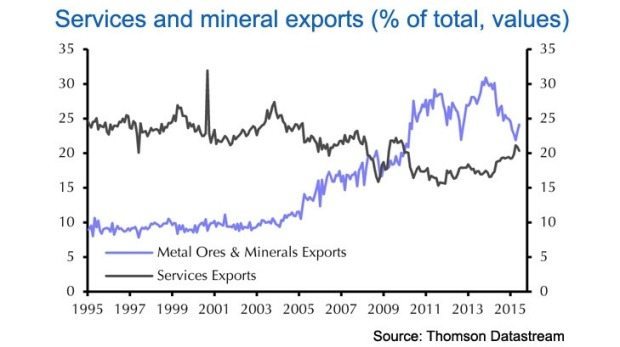
Resources exports have dropped to 24 per cent of total exports compared to 30 per cent of total exports in late 2013, said the paper. Over the same period, services exports had risen to 20 per cent of total exports compared to 17 per cent of total exports in 2013.
“This means that services exports are not far off from being more important to the economy than exports of metal ores and minerals,” it said.
Net exports of services boosted GDP growth by 0.6 percentage points in the first quarter of 2015 – a quarter of the 2.3 percent annual rise in GDP, said the paper.
However, this improvement in net exports of services is “entirely the result of the weaker Australian dollar”.
Since the first quarter of 2013, over 70 per cent of the increase in net services exports has come from the education and tourism category, the paper said.
“This is all down to the dollar, which has made holidaying and learning in Australia more attractive to those overseas, and holidaying and learning overseas less attractive to those at home.”
However, in the near term, it would take a dramatic fall in the Australian dollar to boost services income to fully compensate for the weakening of the resources sector, the paper said.
A drop in the Australian dollar on a trade-weighted basis – from its current level of 63 to, say, 58 by the end of 2016 – would boost net exports of tourism-related services from $2.4 billion to $3.4 billion.
But as a proportion of economic growth, that increase would add just 0.2 percentage points to real GDP growth spread over 2015 and 2016.
“The boost to GDP growth from net services exports may fade before long,” the paper said.
“Unless the Australian dollar were to weaken much further, the economy can’t rely on the strength of net exports of services to continue to compensate for the weaker performance of the resources sector.”
Economist Saul Eslake, formerly of Bank of America Merrill Lynch, said that the post-mining boom economy, including services, had filled the employment gap better than the economic growth gap.
Reserve Bank assistant governor Christopher Kent gave a speech on a similar theme last week.
“Even though GDP growth has been significantly below trend, the unemployment rate has stopped rising,” said Mr Eslake..
It was inevitable that growth in services would continue, and producing “higher-value” services jobs was a way that Australia could increase its economic growth, he said. Services jobs did not have to be low-income menial work, such as flipping hamburgers or taking the nits out of washing, he said.
“It’s important that Australians and Australian politicians stop making the value judgments they sometimes make about services employment,” he said.
The Capital Economics paper came as the DFP Recruitment Mining and Resources job index showed a 22.1 per cent decline in vacancies advertised in the first half of 2015.
Geoscientists, employed by the mining industry to research minerals, are suffering record unemployment. The Australian Institute of Geoscientists said the employment levels had reached their lowest since surveys began in 2009, with an unemployment and underemployment rate of 35.1 per cent.
The data shows “just how severely the prolonged downturn in employment prospects for geoscientists is starting to bite,” the institute said.
Re