

A new way to harvest asteroid resources is being eyed as a possible game changer for space exploration.
The patent-pending innovation, called “optical mining,” could allow huge amounts of asteroid water to be tapped, advocates say. This water, in turn, could provide relatively cheap and accessible propellant for voyaging spacecraft, lowering the cost of spaceflight significantly.
Development of the optical-mining idea has been funded by a NASA Innovative Advanced Concepts (NIAC) fellowship and grant, along with a small business contract. The concept — which is also known as the Asteroid Provided In-Situ Supplies plan, or Apis — was detailed here during a special NIAC session held on Sept. 2 during the American Institute of Aeronautics and Astronautics’ (AIAA) Space 2015 meeting.
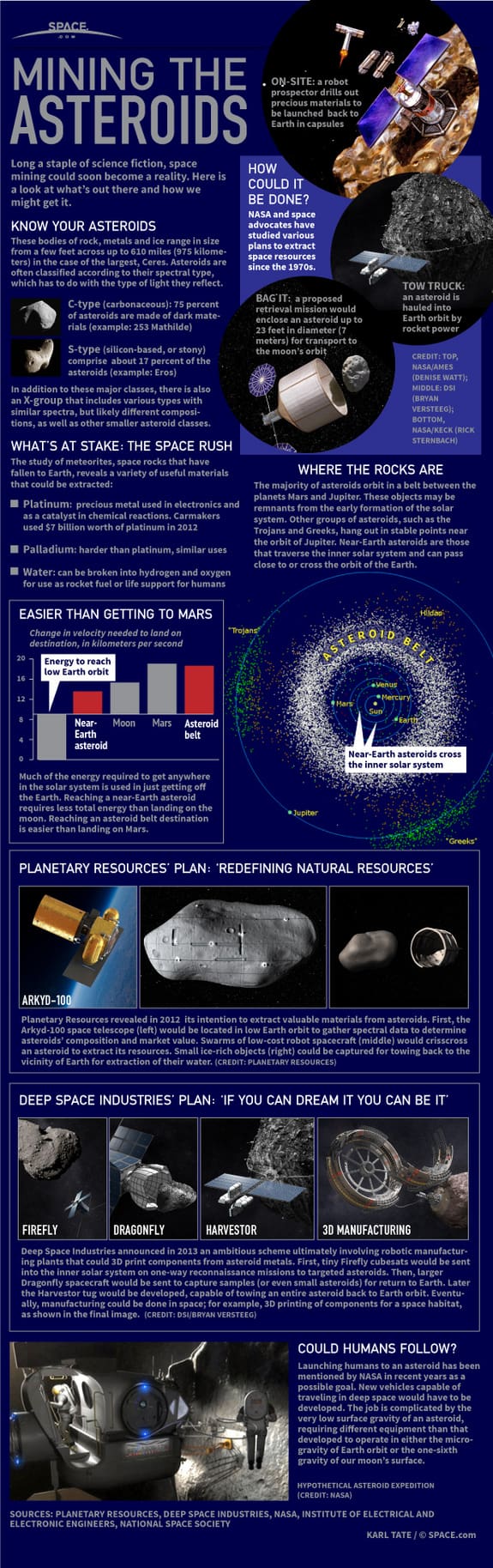
Long a staple of science fiction, space mining could soon become a reality. Here is a look at what’s out there and how we might get it.
These bodies of rock, metals and ice range in size from a few feet across up to 610 miles (975 kilometers) in the case of the largest, Ceres. Asteroids are often classified according to their spectral type, which has to do with the type of light they reflect.
C-type (carbonaceous): 75 percent of asteroids are made of dark materials (example: 253 Mathilde)
S-type (silicon-based, or stony) comprise about 17 percent of the asteroids (example: Eros)
In addition to these major classes, there is also an X-group that includes various types with similar spectra, but likely different compositions, as well as other smaller asteroid classes.
The study of meteorites, space rocks that have fallen to Earth, reveals a variety of useful materials that could be extracted:
• Platinum: precious metal used in electronics and as a catalyst in chemical reactions. Carmakers used $7 billion worth of platinum in 2012
• Palladium: harder than platinum, similar uses
• Water: can be broken into hydrogen and oxygen for use as rocket fuel or life support for humans
The majority of asteroids orbit in a belt between the planets Mars and Jupiter. These objects may be remnants from the early formation of the solar system. Other groups of asteroids, such as the Trojans and Greeks, hang out in stable points near the orbit of Jupiter. Near-Earth asteroids are those that traverse the inner solar system and can pass close to or cross the orbit of the Earth.
Much of the energy required to get anywhere in the solar system is used in just getting off the Earth. Reaching a near-Earth asteroid requires less total energy than landing on the moon. Reaching an asteroid belt destination is easier than landing on Mars.
Planetary Resources revealed in 2012 its intention to extract valuable materials from asteroids. First, the Arkyd-100 space telescope would be located in low Earth orbit to gather spectral data to determine asteroids’ composition and market value. Swarms of low-cost robot spacecraft would crisscross an asteroid to extract its resources. Small ice-rich objects could be captured for towing back to the vicinity of Earth for extraction of their water.
Deep Space Industries announced in 2013 an ambitious scheme ultimately involving robotic manufacturing plants that could 3D print components from asteroid metals. First, tiny Firefly cubesats would be sent into the inner solar system on one-way reconnaissance missions to targeted asteroids. Then, larger Dragonfly spacecraft would be sent to capture samples (or even small asteroids) for return to Earth. Later the Harvestor tug would be developed, capable of towing an entire asteroid back to Earth orbit. Eventually, manufacturing could be done in space; for example, 3D printing of components for a space habitat.
Launching humans to an asteroid has been mentioned by NASA in recent years as a possible goal. New vehicles capable of traveling in deep space would have to be developed. The job is complicated by the very low surface gravity of an asteroid, requiring different equipment than that developed to operate in either the microgravity of Earth orbit or the one-sixth gravity of our moon’s surface.
The new company Planetary Resources, Inc., is backed by a team of billionaire investors and luminaries like filmmaker/explorer James Cameron with a single goal: to mine near-Earth asteroids for precious resources like rare metals and water ice. The project is aimed at tapping into the resources of the solar system while furthering space exploration in an audacious way. See how asteroid mines like those envisioned by Planetary Resources could work in the SPACE.com infographic above.
Space.com